Highlights from the EPOCH-Translate Centre of Research Excellence Evidence to Action Forum
Promoting optimal child growth and wellbeing: insights and practical tools for policy and practice
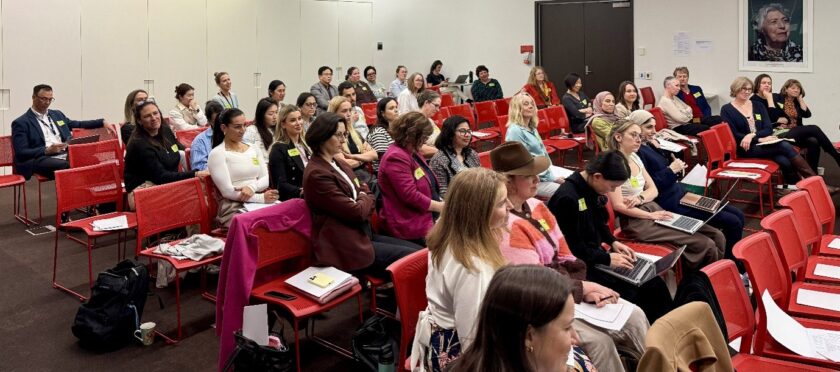
On 8 September 2026, more than 140 researchers, practitioners, and policymakers came together online and in person at the Charles Perkins Centre, University of Sydney, for the EPOCH-Translate Centre of Research Excellence Evidence to Action Forum. Facilitated by Associate Professor Nadia Mastersson of The Australian Prevention Partnership Centre, the Forum shared key learnings from 11 years of NHMRC-funded research collaboration and explored how evidence can be translated into real-world action to improve child health outcomes.
Professor Louise Baur, Director of EPOCH-Translate CRE, opened the Forum by highlighting the importance of preventing obesity in early childhood for immediate and longer-term health. Louise showcased EPOCH-Translate’s achievements in generating evidence relevant to policy and practice, developing practical resources such as evidence briefs for policy decision-makers and measurement tools for diet and physical activity, delivering national webinars, supporting early- to mid-career researcher capacity-building, and establishing the EPOCH-Connect Community of Practice.
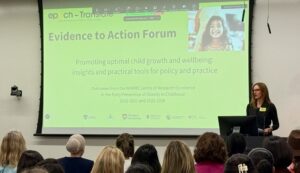
Associate Professor Nadia Mastersson
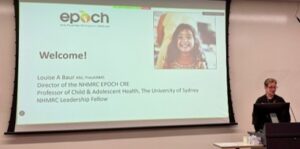
Professor Louise Baur
1) Why invest early?
Professor Alison Hayes and Dr Vicki Brown presented evidence on the economic case for investing in early childhood obesity prevention. They highlighted the increased healthcare costs and reduced health-related quality of life associated with childhood overweight and obesity, and the stark socioeconomic inequalities in obesity prevalence in early childhood. The Health Economic Models, developed through the EPOCH and EPOCH-Translate CREs to predict future costs and benefits of early childhood obesity prevention interventions and generate evidence on their cost-effectiveness, are available here.
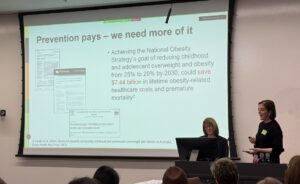
L to R: Professor Alison Hayes and Dr Vicki Brown
2) What should we do, and how do we decide?
Dr Kylie Hunter presented findings from the TOPCHILD study, which is the largest global analysis of early childhood obesity prevention trials to date. The study showed that early childhood obesity prevention interventions did not improve BMI in children at age 2 years. These findings highlight the need to address the broader obesogenic environment and take a whole-system approach to preventing obesity in early childhood.
Dr Konsita Kuswara shared what it takes to integrate early childhood obesity prevention into routine primary health care, highlighting the need to make prevention core business, connect care around families and create opportunities for the primary healthcare workforce to deliver preventive care. Her presentation highlighted the role of early childhood education and social and community services in supporting optimal child growth and connecting families with appropriate support.
Dr Brittany J Johnson presented the Child Health Evidence Hub. The Hub is a comprehensive library that brings together evidence relating to child nutrition, movement, sleep and growth. It was created to support program planners and service providers to find and use evidence when designing, adapting and delivering programs and services for families with young children in Australia.
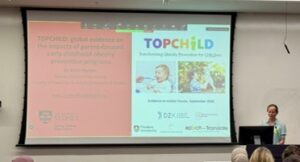
Dr Kylie Hunter
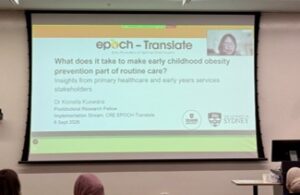
Dr Konsita Kuswara
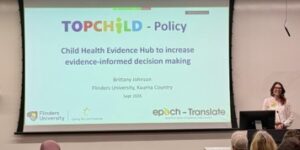
Dr Brittany Johnson
This session focused on real-world implementation lessons from the INFANT and Healthy Beginnings programs.
Dr Jessica Appleton presented her case study exploring the key factors influencing the adoption, integration and scale-up of INFANT and Healthy Beginnings programs. Dr Sarah Taki and Dr Erin Kerr presented on the adaptation of the Healthy Beginnings program for SMS delivery and its integration into health services to improve family engagement.
Dr Jessica Appleton
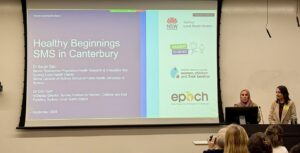
L to R: Dr Sarah Taki and Dr Erin Kerr
Associate Professor Rachel Laws shared learnings from the INFANT program at scale on reaching priority populations, illustrating the value of flexible program delivery and promotion beyond mainstream health services. Dr Ioanna Katiforis presented her qualitative study on the implementation strategies supporting the sustainment of the INFANT program at scale.
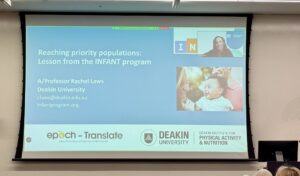
Associate Professor Rachel Laws
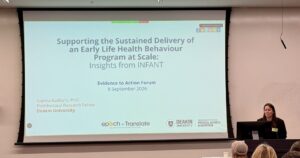
Dr Ioanna Katiforis
Interactive panel discussion: Where to next? Future directions and priorities for policy, practice and research to support early childhood growth, development and wellbeing
The Forum concluded with an excellent interactive panel discussion, featuring prevention experts Professor Andrew Milat, Ms Marina Bowshall and Associate Professor Veronica Graham. Panel members emphasised the importance of working across sectors and building strong partnerships to improve early childhood health outcomes in Australia. The discussion highlighted that preventing obesity in early childhood requires a systems approach, with multiple, complementary strategies. These include supporting children and their families, implementing appropriate policy and legislation, improving the environments in which children live, and addressing the broader determinants of health.
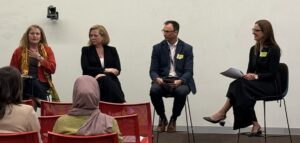
L to R: Associate Professor Veronica Graham, Ms Marina Bowshall, Professor Andrew Milat, Associate Professor Nadia Mastersson
Recordings of the Evidence to Action Forum sessions are available on our website at this link. We encourage you to share them with your networks.