
Introduction
This brief examines how programs can be implemented, adapted and scaled up for different populations and settings. It covers:
- Evidence, strategies and tools to support implementation
- What we have learnt about adapting programs to address equity and contextual differences, while maintaining core program elements
- How to ensure the feasibility of scaling up and the sustainability of programs once scaled up.
We are studying these implementation challenges in two evidence-based programs:
Key Points
- Successful implementation of early childhood health promotion initiatives requires coordinated systems with supportive policies, skilled workforces, and accessible evidence-based resources.
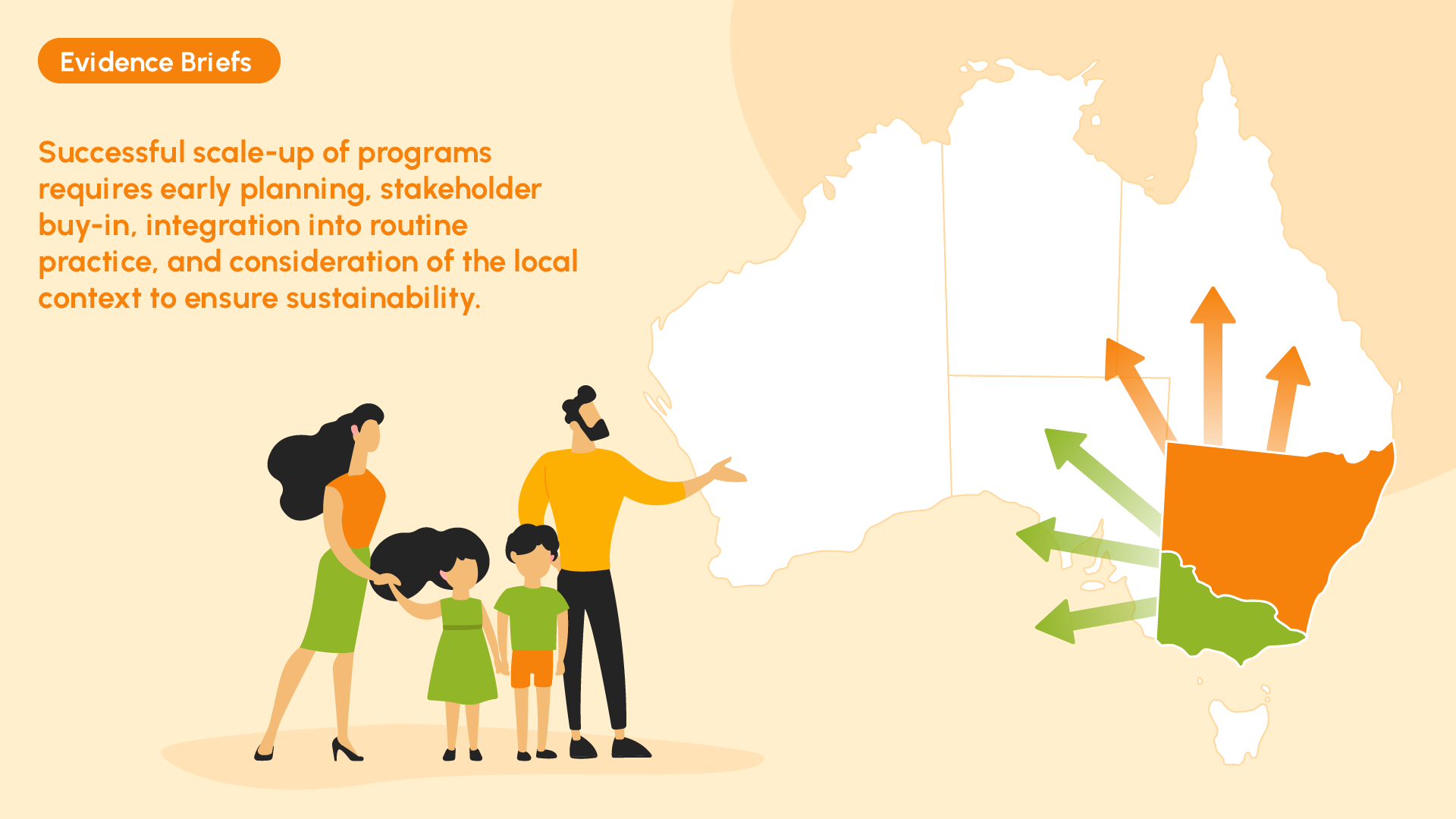
- Successful scale-up of programs requires early planning, stakeholder buy-in, integration into routine practice, and consideration of the local context to ensure sustainability.
- Adapting health promotion programs for digital platforms can enhance accessibility and equity.
- Careful design and integration with services to maintain fidelity and sustainability is needed when adapting programs to promote health behaviours in early childhood.
- Engaging parents in early childhood health promotion is most effective when using strengths-based, equity-informed, flexible approaches that build confidence and sustain positive behaviours.
Healthy Beginnings Home-based Program
Healthy Beginnings is a staged early intervention program to prevent childhood obesity, run in partnership with the University of Sydney and Local Health Districts in NSW. It involves eight home visits by Child and Family Health Nurses from late pregnancy to age 2, focusing on improving family and behavioural risk factors for childhood obesity, such as improving infant feeding practices.
INFANT program
The INFANT program, developed by Institute for Physical Activity and Nutrition, Deakin University, is implemented in partnership with Victorian Department of Health and multiple other practice partners. The program provides anticipatory guidance on feeding, active play and screen time from birth to 18 months of age. It consists of four group sessions delivered by trained health and early years professionals and complemented by a mobile phone app for parents and carers.
For more information on key settings, populations and program components, please refer to:
- Evidence Brief 2: Evidence-based approaches to promoting health behaviours and preventing obesity in early childhood
- Policy brief: Integrating early childhood obesity prevention into health services
- Policy brief: National leadership needed to prevent obesity in early childhood
Evidence, strategies and tools to support implementation and scale-up
Successful implementation of initiatives to promote health behaviour in early childhood depends on a supportive and joined-up system. Implementation science theories, models, and frameworks offer structured approaches to translating research into the real world. When applied within an enabling system, these tools can enhance the adoption, implementation, and sustainability of early childhood feeding, nutrition, and active play programs.
To achieve impact, evidence-based initiatives must be scaled up and reach families most in need of support. Scaling up can take a vertical approach, introducing an intervention across an entire system at once, or a horizontal approach, rolling it out gradually across different sites or groups (Milat et al., 2016).
Following its small-scale implementation in eight local government areas, the INFANT program is now being scaled up to 76 local government areas across Victoria. Our implementation research examines how the program is delivered across diverse organisations, why and how it is adapted over time, the impact of adapting different program components, the effectiveness of various implementation strategies, and what works to enable the program to be sustained. This research also considers the strategic, political, and environmental contextual factors that influence scale-up, recognising that the process can be complex and dynamic (Milat et al., 2020).
Key learnings for policy makers
Our work has identified elements for successful implementation and scale-up of programs to promote child health behaviours:
- Plan for implementation and sustainability from the outset to direct resources towards interventions most likely to succeed at scale. Allowing sufficient time for effective service delivery and to achieve sustained implementation.
- Develop supportive policies that prioritise health promotion and prevention, alongside secure and ongoing funding to build workforce capacity.
- Engage key stakeholders early and ensure organisational readiness, including leadership buy-in and alignment of program outcomes with organisational priorities.
- Base implementation decisions on strong evidence while maintaining flexibility to adapt interventions to meet local needs.
- Integrate interventions within existing workflows, systems and service delivery, and clearly communicate the relative advantage of the intervention.
- Establish mechanisms to support cross-sector collaboration, consistent messaging and coordinated actions across early childhood services.
- Facilitate joined-up action using a food systems approach and funded capacity to deliver coordinated and integrated services to address nutrition across the first 2000 days.
- Engage external implementation coaches or facilitators to support implementation initially, with a plan for gradual withdrawal while maintaining delivery.
- Weigh potential benefits against challenges to determine whether scaling an intervention is likely to be effective or sustainable. Implementation strategies are influenced by local context, and some may not be appropriate to be implemented at scale.
Evidence
Translating an early childhood obesity prevention program for local community implementation: a case study of the Melbourne INFANT Program
The translation of the INFANT program into eight local government areas highlighted several factors essential for successful implementation. Key facilitators included having a pre-packaged, evidence-based program that met community needs, strong partnerships between researchers, policy makers, and local services, and ongoing training and support for implementers. We found that embedding delivery within existing workforce roles and adapting the program to local contexts supported feasibility and sustainability, though maintaining fidelity was an ongoing challenge. Sustained funding and continued collaboration between researchers and end users are critical to ensure effective programs like INFANT are integrated and sustained in practice.
We found that sustained implementation of the INFANT program depended on factors such as ongoing funding, organisational support and capacity, integration into routine practice, clear partner roles, and early planning for sustainability. Our study highlights that successful scale-up of population health interventions requires not only evidence of effectiveness but also proof that they can be sustained within local and organisational systems. These findings align with global evidence on what enables the long-term success of health promotion programs across healthcare, education, and community settings.
This protocol paper describes our study – the first known study to evaluate the scale up of an evidence-based early childhood obesity prevention intervention under real world conditions.
We outlined key opportunities to improve nutrition across the first 2000 days of life within national, state and local government systems, using policy, practice and research mechanisms. More joined-up action and greater program/policy coherence is needed, with funded capacity to facilitate the delivery of coordinated and integrated services to address nutrition in the first 2000 days.
This report highlights the diverse experiences of caregivers in South Australia, revealing gaps in support, especially for socially disadvantaged families and fathers. It identifies opportunities to improve service accessibility, coordination, and focus on caregivers of young children, ensuring better support for all families during the early years.
While both early childhood obesity prevention programs have been successfully adapted and integrated into service delivery one has achieved wider spread throughout the state. Factors that facilitated scale-up were a robust evidence base, positive response to the program from parents, adaptability of the program features to suit varied contexts, inclusion within policy documents/strategies and champions at multiple levels of the health system who garnered support and buy-in for the program. Barriers included a perceived high cost of the program, a non-flexible interpretation of current service delivery and unclear jurisdictional responsibility in the wider health system.
Additional insights from our scale-up research will be added to this section as they are published.
Tools for policy makers
Child health evidence dashboard
TOPCHILD-Policy have created a dashboard (i.e. interactive website or hub) bringing together an evidence base of child health behaviour research including initiatives and evidence summaries from the TOPCHILD Collaboration. It was co-designed with next users including program planners, policy makers, service and organisation managers and researchers in the early years system. The dashboard aims to support evidence informed decision-making on what strategies, programs or services to implement and endorse to promote child health behaviours.
You can express interest in helping to evaluate the dashboard at this link:
Support for analysing interventions, finding health economic evidence and building the health economic case, and integrating early childhood obesity prevention into health services.
Our review found that implementation science theories, models and frameworks can strengthen the real-world implementation of early childhood feeding, nutrition, and active play interventions. It recommends their more systematic use to guide planning, implementation, and evaluation.
Making sense of implementation theories, models and frameworks
This article presents five categories of theoretical approaches to implementation. Understanding their differences can help in selecting the most relevant approach for different contexts.
Implementing policies and programs in prevention
This synthesis of implementation research from the Collaboration for Enhanced Research Impact and the Prevention Centre provides evidence and tools to support the real-world adoption, delivery, scale-up, and sustainability of policies and programs. It helps policy makers and practitioners to select effective initiatives, optimise delivery, adapt and scale for greater reach and equity, and sustain implementation to maintain long-term impact.
Implementation Scalability Assessment Tool
The Implementation Scalability Assessment Tool (ISAT), developed in Australia, is designed to assess the suitability of health interventions for scale-up. It evaluates key domains such as feasibility, reach, effectiveness, and alignment with policy priorities. The ISAT can help policy makers, practitioners, and program managers make evidence-based decisions about scaling up interventions and identify factors that may need further attention.
Program Sustainability Assessment Tool
The Program Sustainability Assessment Tool (PSAT) is designed to assess a health program’s capacity for sustainability. It evaluates domains known to influence sustainability, including funding stability, organisational capacity, partnerships, and strategic planning. The PSAT provides a framework to identify strengths and areas for improvement to enhance long-term program sustainability.
Implementation Strategies Applied in Communities compilation
The Implementation Strategies Applied in Communities (ISAC) compilation is a guidance tool that supports the selection and application of implementation strategies for evidence-based interventions delivered in community settings. The ISAC compilation can help policy makers and practitioners identify effective strategies, overcome barriers, and improve intervention delivery; in turn supporting sustained implementation and long-term impact of community interventions.
Primary healthcare professionals need coordinated support including:
- Legitimacy and adequate resourcing from service leaders, policy makers, and professional associations to embed health promotion, including nutrition, physical activity, sedentary behaviour and sleep, within routine consultations.
- Access to appropriate equipment and tools to screen and monitor growth and related health behaviours
- Targeted professional development to build knowledge and skills in:
- The evidence-base for promoting health behaviours in early childhood (e.g., Connecting the Dots; INFANT training for early years professionals)
- Monitoring growth and identifying at-risk behaviours (EPOCH-Translate brief screening tools; WHO charts)
- Brief motivational interviewing techniques
- Consistent key messages to promote health behaviours to children and families (e.g., 8 Healthy Habits)
- Sensitive communication strategies that focus on behaviours rather than weight (INFANT and Healthy Beginnings parent resources)
- A repository including relevant guidelines, clinical resources, and parent hand-outs relevant to healthy eating, physical activity, limiting sedentary behaviour, and adequate sleep in early childhood.
- A coordinated national approach to disseminate education and training through reputable organisations, such as Primary Health Networks (PHNs), Maternal, Child and Family Health Nurses Australia (MCaFHNA), and the Royal Australian College of General Practitioners (RACGP).
Evidence
Guided by the Ottawa Charter, we proposed actions to strengthen health promotion in primary healthcare to improve child health outcomes. Australian primary healthcare services tend to be reactive, focusing on treating illnesses rather than promoting health and wellbeing. Implementation support is needed to reorient services towards prevention and to guide practitioners in delivering effective, strength-based approaches to support health behaviour development.
We conducted a national needs assessment with Australian primary health professionals and identified that they recognise the importance of child health promotion, but gaps in knowledge, confidence, and organisational support hinder their ability to effectively implement preventive care. This highlights the need for targeted training and structural changes.
Our study with child and family health nurses in two health districts in NSW identified needs for education and support in promoting optimal child growth and development. This included training in behaviour change techniques to engage parents in challenging conversations around healthy weight gain; resources for parents in non-English community languages or tailored to different cultural and religious groups; and resources to support parental health literacy.
We conducted a review to explore parents’ experiences of engaging with primary health professionals for support with child health behaviours and growth in the early years. Primary health professionals are an important source of support regarding child nutrition and feeding, however, their role in supporting other child health behaviours (like physical activity and sedentary behaviour) is less well described. Primary health professional capacity to support early childhood health promotion could be enhanced through development of clinical tools and training to promote consistent messaging in primary healthcare.
Tools for health professionals
Talking to families
One-page resources with simple, actionable advice about healthy eating and physical activity to support children’s growth, development and wellbeing.
Healthy Beginnings parenting booklets
The Healthy Beginnings program offers a series of 14 parenting booklets designed to support parents from pregnancy through to their child’s fourth year. These booklets provide evidence-based guidance on infant feeding, physical activity, and healthy behaviours to promote children’s health and development from birth.
These resources support mums, dads and carers with evidence-based feeding and active play advice for babies aged 3, 6, 9 and 12 months of age and have been carefully curated to complement the four INFANT group sessions.
The My Baby Now app complements the INFANT program. It was co-designed with parents, maternal and child health nurses and experts at the Institute for Physical Activity and Nutrition, Deakin University and the University of Sydney.
The Grow & Go Toolbox is one stop shop trustworthy resources on food and nutrition for children under 5, designed for parents, families and early childhood and health professionals. It covers a variety of topics including breastfeeding and introducing solid, fussy eating and allergies.
Small Bites for Big Steps is a video resource designed to support early childhood educators, families, and carers promote healthy development during children’s first 2,000 days. It includes 49 on-demand videos with practical information and expert guidance from allied health and child and family health professionals.
Dinnertime with Isla, developed by the Sydney Local Health District’s Health Promotion Unit, includes a children’s storybook and animated music video to support families of toddlers and pre-schoolers with strategies for fuss-free mealtimes.
Health behaviour screening tools
Measurement Tools – EPOCH-Translate (earlychildhoodobesity.com)
Brief measurement tools that measure diet, physical activity, screen time and sleep of children under five years.
The EPOCH Dietary Questionnaire (EPOCH-DQ) can be used to assess dietary behaviours in children under 5 years. Three age-appropriate versions are available for (1) infants, aged 6–12 months, (2) toddlers, aged 1–2.9 years and (3) pre-schoolers, aged 3–5 years.
Professional development resources
In partnership with Karitane, a not-for-profit parenting service, we have incorporated key messages from the Healthy Beginnings program into the Connecting the Dots National Nutrition Service (CTD). CTD consists of pre-recorded webinars for health professionals and resources for parents, primary healthcare professionals and early childhood education and care professionals.
INFANT training for early years professionals
This 6–8-hour online training course provides that latest evidence on healthy eating and active play in the early years. Participants will learn about the content and delivery of the INFANT program including key messages and developing a plan to implement the program in your community context.
Early childhood services outside the health sector, such as playgroups, early childhood education and care, and early parenting support need:
- To support and train their staff with:
- Evidence on the importance of healthy eating, activity and sleep behaviours to child development including educational, social, emotional outcomes
- Ideas on how to embed health promotion messages, such as responsive feeding practices, as part of their routine service delivery
- Strategies to engage children and parents/carers holistically using a strength-based approach
- Access to implementation support to deliver effective health promotion interventions in their services
- Tailored solutions and resources to promote health, particularly those from diverse linguistic/cultural backgrounds or with social and economic disadvantages.
Evidence
Embedding health promotion messages in non-health services
ECEC educators see feeding as key to their role but face barriers like personal beliefs, conflicting parent requests, and unsupportive centre-based policies. Training in responsive feeding for all childcare staff and stronger centre-wide policies are needed to support healthy food provision and desirable feeding practices.
Little Aussie Bugs is a storybook-based program that helps children aged two to four build healthy habits through engaging “healthy” and “ugly” bug characters and dialogic storytelling. Piloted in Western Australian ECEC services, educators reported high satisfaction, increased confidence in delivering health messages, and strong child engagement, though benefits were less pronounced among those less familiar with dialogic reading. Further research is planned to inform the design of effective professional learning to complement the resources, supporting educators to optimise their use of the books and promote sustained delivery of health literacy messaging in ECEC settings.
A great way to bring up health behaviour topics at playgroup: a qualitative evaluation of the Healthy Conversations @ Playgroup program
This evaluation of the Healthy Conversations @ Playgroup program highlights the value of peer support in creating a safe space for parents to share experiences and strategies, boosting confidence and promoting autonomy-based parenting at home. Importantly, the evaluation found that parenting challenges must be normalised, with a shared understanding that what works for one family may not work for another, and that no parent is perfect.
Health promotion support services, training, and resources for non-health early childhood services
Early Childhood Education and Care
Munch and Move (NSW)
Training and resources for ECEC educators to promote healthy eating and physical activity as part of the learning and care programs. Funded and managed by NSW Ministry of Health. Available statewide for ECEC services in NSW at no cost.
Nourishing Little Minds (ACT)
Training programs and resources to help ECEC services in ACT provide and promote healthy eating. Delivered by ACT Nutrition Support Service as part of Nutrition Australia ACT.
Healthy Eating Advisory Service (VIC)
A suite of resources, trainings, tools and advisory services to help ECEC settings create a healthy eating environment. Available statewide for ECEC services in VIC at no cost.
Movement Environment Rating Scale (MOVERS) (VIC)
Professional training sessions to improve the quality of the movement environment in ECEC settings. In-person and online delivery modes available.
Move Well Eat Well (TAS)
Statewide support and award program to encourage healthy eating and physical activity in ECEC settings. Funded and managed by Public Health Services, TAS Department of Health. The program is currently being evaluated and refreshed.
Nutrition in Early Childhood Education and Care urban areas (NT)
A self-directed online course designed to educate ECEC staff about the nutritional requirements of young children, developing nutritional policy and planning a healthy menu. Developed and delivered by Top End Regional Health Services Dietitian team within NT Health. The team may provide additional support as requested by ECEC services.
Food Foundations (QLD)
A range of tailored resources, trainings, and support services to promote healthy eating in ECEC settings. Services are delivered by Nutrition Australia QLD on a pay per use basis or ongoing subscription for a modest fee.
Professional development, resources, and support to help ECEC services promote physical activity. Services can access tailored support and resources by becoming a member.
A series of four storybooks featuring “ugly bugs” that can harm health and “healthy bugs” that promote gut wellbeing, paired with practical educator and parent resources in both print and digital formats to reinforce learning.
Early childhood / parenting social and community services
We are not aware of any tailored interventions or resources specifically designed to promote healthy eating and active play for early childhood social and community services that are ready for immediate implementation. However, there are resources that have been adapted for priority populations (see Brief 4) that may be useful for these services.
Strength-based approaches to engaging parents in promoting child health
Engaging parents in promoting healthy behaviours in young children is essential but can be challenging. Evidence highlights that a strengths-based, equity-informed approach which builds on parents’ existing skills, involves fathers, and uses tailored, flexible strategies, can increase parents’ confidence, and helping to sustain positive health behaviours in children.
Programs such as Healthy Beginnings and INFANT illustrate this approach in practice. Both build on parents’ existing strengths and potential, using co-designed strategies and flexible delivery methods, to enhance engagement and accessibility.
Evidence
We interviewed parents in the INFANT program to explore factors affecting engagement. Engagement was shaped by the transition to parenthood and program processes, with enablers and barriers at personal, organisational, and program levels. Key motivators included parents’ need for guidance, especially on infant feeding, and opportunities to share experiences and build social connections. Engagement was reduced when parents faced stress, difficulty adjusting to their baby’s routine, or relied on informal information sources. Suggested strategies to enhance parental engagement are outlined in the paper.
We presented the conceptual “CO-Parent” model, which highlights the vital role of fathers as well as mothers in obesity prevention from preconception through early childhood. Grounded in couple interdependence theory and a socioecological framework, our model promotes shared responsibility for child health beginning in the preconception period.
Australian fathers play a key role in getting healthy meals on the table, often sharing food tasks and showing strong confidence and interest. We showed that time pressures remain a barrier, highlighting the need for practical resources to support their involvement in planning, shopping, and cooking for the family.
Fathers were aware of the importance of their role and had high self-efficacy in positively influencing their children’s nutrition and physical activity. While fathers were committed to gaining knowledge to support their children’s dietary and physical activity behaviours positively, many found that useful information was difficult to locate. The findings demonstrate that providing father-specific, accessible and evidence-based resources can help fathers promote positive health behaviours in their children.
A U.S study used human-centered design to explore how parents of infants under 24 months perceive and prefer discussions about early life obesity risk. Virtual sessions with 31 parents showed that parents are open to these conversations when framed positively, emphasising healthy changes for the whole family rather than weight loss, and delivered with appropriate tone, context, and collaboration. The findings offer a parent-centred approach to guide early childhood professionals in supporting early obesity prevention strategies.
Adaptation
Initiatives need to be adapted for different settings and populations, and to ensure equity. However, there is the risk that fidelity can be lost when policies and programs are adapted.
We are studying the adaptation of Healthy Beginnings, originally a home-visiting program, to a telephone and web-based program. The Communicating Healthy Beginnings Advice by Telephone (CHAT) trialled a free program that provided parents with brochures, text messages/telephone support to guide healthy behaviours from before birth to 4 years.
Adaptations to the INFANT program have also been examined and are continuing to be explored in the ongoing hybrid trial of the scale up of INFANT program in Victoria.
The following section outlines our key learnings and insights with supporting evidence.
Researchers’ insights on adapting to digital/phone-based platforms:

- Accessibility and inclusivity: Digital and telephone-based interventions should be designed with accessibility in mind, addressing potential barriers like digital literacy, language, and internet access.
- Integration with existing health services: Digital-based interventions should complement existing health services. Policy makers should support integration into broader healthcare systems for sustainability and impact.
- Adapt to diverse formats: Provide content in various formats (video, audio, text) to cater to different learning preferences and literacy levels, which is particularly important in multilingual communities.
- Iterative feedback: Regularly gather and incorporate feedback from users to continuously improve the relevance of the materials, ensuring long-term success when scaling up.
- Ownership of web development assets: Ensure that website coding and intellectual property rights are contractually secured from developers. In the case of unforeseen events like liquidation (as experienced in our project), having access to the website’s source code and rights is critical for continuity, allowing the program to proceed without legal or technical delays.
Evidence
Our learnings from the program adaptations are yet to be published and will be added to this section once published.
Within the Communicating Healthy Beginnings Advice by Telephone (CHAT) study, scheduled nurse telephone support played a critical role in delivering tailored intervention messages, facilitating targeted behaviour change, and identifying additional cobenefits that enable greater impact. Scheduled nurse telephone support played a critical role in delivering tailored intervention messages, facilitating targeted behaviour change, and identifying additional cobenefits that enable greater impact. The cobenefits for participants identified encompassed factors related to the social determinants of health, including psychosocial support for financial security, relationship challenges and mental health.
Lessons on early childhood obesity prevention interventions from the Victorian Infant Program
As part of the Healthy Together initiative, we adapted the INFANT program during a small-scale translation across eight local government areas. We found that tailoring the program to local contexts was key to ongoing delivery. For example, we reduced the number of sessions from six to four, and some sites offered the first INFANT session as part of first-time parent groups to allow parents to opt in. These adaptations helped integrate the program into routine practice, supporting sustained implementation.
Tools
CHAT Telephone Support Scripts
The CHAT tele-support service demonstrated the value of structured telephone-based conversations in engaging hard-to-reach groups, including socially isolated women, those in regional areas, and women from low socioeconomic or culturally diverse backgrounds. The CHAT Telephone Support Script (eAppendix 1) serves as a practical tool for health professionals, offering a structured approach to guide supportive, effective conversations with parents about infant health behaviours.
Healthy Beginnings for HNEKids
This free text messaging program, adapted from CHAT, is offered to families as part of routine care through Hunter New England Local Health District Child and Family Health Services. It demonstrates how a health service has implemented the text message support model developed in the CHAT study.
 Get a copy of this page in PDF format