
This guide aims to help you make the case for investment in health promotion and obesity prevention in early childhood. It summarises findings from work by CRE EPOCH-Translate since 2021 and references other relevant sources where appropriate.
For more evidence on building the case for action, see the evidence briefs summarising our foundation research up to 2020.
Key Points
- Obesity in Australian children under 5 years is costly and reduces quality of life
- Early childhood is a critical time to establish and support healthy habits that last a lifetime
- There is a compelling economic case for obesity prevention in early childhood
- Obesity prevention has numerous other benefits for children
- Addressing health behaviours in young children benefits the whole family and community
Overweight and Obesity in Australian children under 5 years is common, costly and reduces quality of life
Six per cent of children aged 2–4 years live with obesity, and one in five children (20%) have overweight or obesity by the time they start school (AIHW). This has a significant negative impact on healthcare costs, children’s health-related quality of life, and educational outcomes.
Even children aged 2-4 years with obesity have higher hospitalisation rates and 60% greater healthcare costs than those with a healthy weight (Hayes et al., 2016). There are significant potential savings from preventing and reducing obesity in children if effects can be sustained as children grow into adults.
Children with overweight or obesity have poorer health-related quality of life, which worsens with age. In contrast, children with a healthy weight generally maintain their health-related quality of life.
Evidence
Costs of childhood overweight and obesity
See our previous evidence brief identifying the costs and benefits of early childhood obesity prevention.
Economic benefits of reducing childhood and adolescent overweight and obesity in Australia
Achieving the National Obesity Strategy’s goal of reducing childhood and adolescent overweight and obesity from 25% to 20% by 2030, could save $7.44 billion in lifetime obesity-related healthcare costs and premature mortality.
Estimating the healthcare costs of overweight and obesity amongst Australian children
More recent analysis has estimated healthcare costs associated with excess weight in middle childhood. Children with obesity had annual costs that were $AUD379 higher than children in healthy weight, or about 40% higher.
Consequences of childhood overweight and obesity
We investigated the association of health-related quality of life (HRQoL), measured with the Paediatric Quality of Life Inventory, with weight status throughout childhood and adolescence. We found middle childhood to be a critical stage for the emergence of weight-related inequalities in HRQoL, which were then sustained into adolescence. The largest decreases in quality of life were associated with obesity and severe obesity in adolescence and with obesity in middle childhood. This study underscores the importance of obesity prevention during early childhood, to avoid the loss of HRQoL in middle childhood and beyond.
See a previous brief that summarises the evidence on the impact of childhood overweight and obesity on health-related quality of life.
Early childhood is a critical time to establish and support healthy habits that last a lifetime
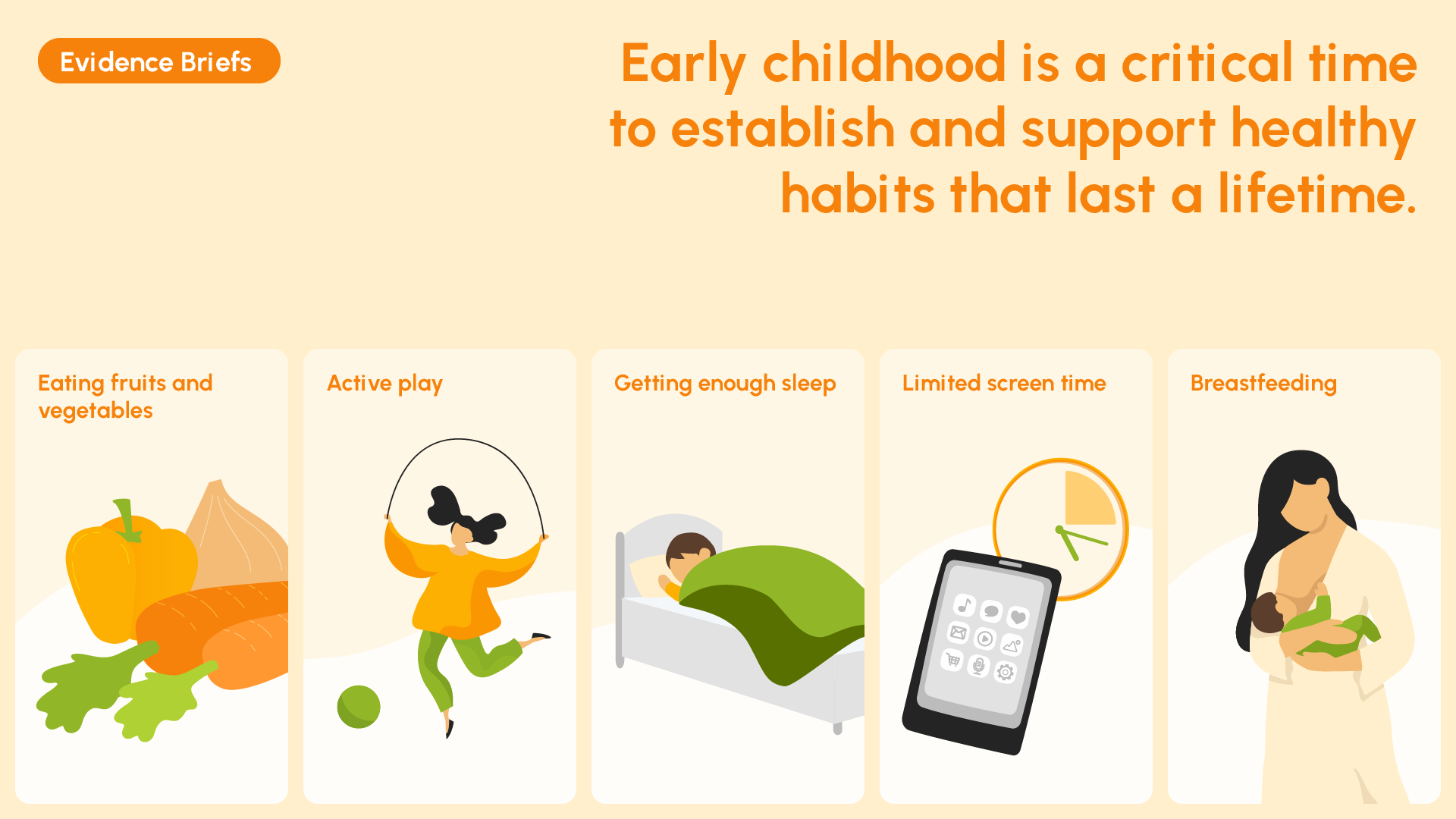
Rapid weight gain in the first two years of life is strongly linked to development of overweight and obesity in later life. Breastfeeding, healthy diet, movement behaviours, and adequate sleep in early childhood all help protect against rapid weight gain.
Children who establish healthy growth, diet and movement behaviours early in life are more likely to sustain a healthy weight and optimal health behaviours into adolescence.
Unhealthy lifestyle patterns begin in early life and is socioeconomically patterned, highlighting the need for increased investment in families with socio-economic disadvantage.
Quick and robust measurement of diet and movement behaviours (screen time, sleep, active play) in young children is essential for monitoring population trends and enabling timely interventions.
Evidence
Children experiencing rapid weight gain during the first 2 years of life had 3.66 times greater odds of experiencing overweight/obesity later in life (from ages 2 to 46.5 years).
Children follow distinct sleep duration trajectories in early childhood. Those with longer nighttime sleep duration have lower BMI z-score trajectories in early childhood. Our findings underscore the importance of adequate nighttime sleep for healthy growth development in early childhood.
The review provides longitudinal evidence linking breastfeeding and BMI trajectories in childhood and adulthood. We found that children who were exclusively or predominantly breastfed between 3-6 months of age had a lower BMI trajectory than those who were formula- or mixed-fed. The between-group differences in BMI increased with age and were evident from age 7 months up to 8 years. This finding substantiates the importance of breastfeeding promotion and continuation to support obesity prevention.
We looked at how BMI/weight status tracks during childhood. We found the highest natural resolution of overweight in children aged under 7 years, suggesting early childhood may be an opportune time for interventions to reduce overweight.
We showed diet, physical activity and sedentary behaviours are interrelated with ‘healthy’ and ‘unhealthy’ patterns that track across early childhood. The unhealthy lifestyle pattern was inversely associated with maternal education, while the healthy lifestyle pattern was positively associated with maternal education.
Can Reducing Childhood Obesity Solve the Obesity Crisis in Australia?
This study modelled the implications of entering adulthood at a lower or higher BMI and how this would influence future numbers of adults with obesity in Australia. We found that targeting and reducing childhood obesity will have only a small and delayed effect on adult obesity levels, by 2040. This highlights the importance of investing in and implementing obesity prevention programs across all ages, including throughout childhood and adulthood.
Tools
Obesity-related behaviour assessment tools
Measurement Tools – EPOCH-Translate (earlychildhoodobesity.com)
Brief measurement tools that measure diet, physical activity, screen time and sleep of children under five years.
We developed the EPOCH Dietary Questionnaire (EPOCH-DQ) to assess dietary behaviours in children under 5 years. Three age-appropriate versions were developed for (1) infants, aged 6–12 months, (2) toddlers, aged 1–2.9 years and (3) pre-schoolers, aged 3–5 years. The EPOCH-DQ shows acceptable validity and reliability, demonstrating potential for widespread use in research and health care settings.
Ongoing work: Development of Core Outcome Measurement Sets (COMS) for obesity-related behaviours in children 0-5 years
We are currently developing two complementary Core Outcome Measurement Sets (COMS) to measure core infant-feeding (SCOPE COMS) and early childhood health behaviours in children aged 0-5 years (EPOCH COMS). Our research will produce a set of validated and appropriate tools to measure infant and child health behaviours at both individual and population levels. These tools will support researchers, health professionals, and policymakers to track changes over time and evaluate the impact of initiatives to prevent early childhood obesity.
For further details and updates on these projects, or to be involved, please see the Open Science Framework pages (SCOPE COMS OSF and EPOCH COMS OSF) or the SCOPE Project Website.
There is a compelling economic case for obesity prevention in early childhood

Our work, and that of many others, shows that even small changes in health behaviours in early childhood can be cost effective and could potentially deliver substantial health benefits and cost savings over a lifetime if their effects were sustained.
We have demonstrated cost-effectiveness of a community delivered program (Romp and Chomp) and family-based programs (CHAT, POI).
Evidence
Potential cost savings from improved health behaviours in early childhood, beginning in early childhood and sustained over the lifetime
Our health economic modelling shows a 1 serve reduction in discretionary food per week could result in approx. $1.3 billion savings in healthcare costs over the lifetime of the Australian population (aged 2 to 100 years) and could prevent over 50,000 cases of type 2 diabetes and 20,000 cases of heart disease nationally.
We found that if all Australian children born in any one year were breastfed to 6 months, overweight and obesity would be reduced and savings in health care costs would amount to AUD$4.4m, over the child and adolescent lifespan. However, there would be little impact on socio-demographic inequalities in overweight and obesity.
We showed that access to an evidence-based infant feeding app may provide substantial savings to the health system and potentially to parents through fewer primary health care visits.
Value for money of different intervention strategies
We found an infant sleep intervention is more cost-effective in low- and mid-SEP groups compared with high-SEP groups. Targeting this intervention to low-SEP groups would be both cost-effective and equity promoting.
We conducted an economic evaluation of the Communicating Healthy Beginnings Advice by Telephone (CHAT) trial to prevent childhood obesity. We found that SMS and telephone interventions were cheaper to deliver and more cost-effective than the home-visiting approach.
We found a telephone and SMS-based intervention to be more effective in children experiencing socioeconomic disadvantage. Modelled economic evaluation over 12 years, from early childhood to adolescence, showed that the intervention was very cost-effective in the lower socioeconomic group and only marginally cost-effective in the higher socioeconomic group. The intervention demonstrated very good value for money and has the potential to reduce inequities in childhood weight.
See our previous evidence brief for the economic evaluation of POI and Romp and Chomp programs. The POI (Prevention of Overweight in Infancy) study in New Zealand was a community-based intervention supporting families from the antenatal period to 18 months, delivered through home visits and group sessions focused on sleep, nutrition, breastfeeding, and physical activity. Romp and Chomp, in Geelong, Australia, targeted children from birth to five years and promoted healthy eating and active play across early childhood centres, childcare services, and broader community settings.
Resources
The EPOCH model and EQ-EPOCH model
We developed the EPOCH model, a computer model (tool) that can predict future costs and benefits of early obesity prevention. It has been used to demonstrate the cost-effectiveness of family based and community delivered obesity/overweight prevention programs. The original model has been adapted to account for equity indicated by socioeconomic position (EQ-EPOCH model).
Obesity prevention has numerous other benefits for children
Good health behaviours in early childhood, such as increased breastfeeding, healthy eating, more physical activity, reduced sedentary behaviours and improved sleep, improve many aspects of children’s lives.
While research in this area is still developing, emerging evidence suggests benefits for children’s academic performance, self-regulation, social and emotional development.
Breastfeeding has been linked to higher child intelligence, and a range of long-term health benefits for both mothers and children.
Evidence
We found a small but significant association between school absenteeism and childhood obesity in Australia – leading to added national costs through lowering caregivers’ productivity.
Longitudinal associations between weight status and academic achievement in primary school children
Our study found that becoming affected by overweight (boys) and remaining affected by overweight (girls) in the transition from preschool / kindergarten to primary school was associated with lower academic achievement at age 9 years (Grade 3), compared with those who remained a healthy weight across both timepoints, regardless of their socioeconomic status. The negative impacts were more pronounced in girls than boys.
A systematic review of the literature suggests that healthy dietary habits and physical activity in early childhood may support cognitive development, such as improved attention, working memory, self-regulation, and academic performance. Most of the evidence came from observational studies, though not all accounted for key confounding factors.
A systematic review of interventions promoting physical activity in early childhood education and care settings found a small increase in children’s social-emotional well-being, though the difference was not statistically significant. Given that only six studies measured social-emotional well-being, more research is needed to clarify the relationship.
We undertook an integrative review of interventions aimed at promoting best practices in formula feeding or bottle weaning for infants and young children, and examined their health impacts. Our findings showed mixed effects on improving weight status, a trend towards reduced tooth decay, mixed reductions in children’s sugary drink consumption, and improvements in parents’ dental health knowledge.
Breastfeeding in the 21st century: epidemiology, mechanisms, and lifelong effect
This 2016 Lancet review suggests that breastfeeding boosts human capital by improving intelligence and provides health benefits to mothers, including a reduced risk of several cancers and diabetes.
Addressing health behaviours in young children benefits the whole family and community
Initiatives and policies designed to improve health behaviours in children often impact individuals and communities who are not the primary targets, a phenomenon termed ‘spillover effects’.
While there is limited evidence on these ‘spillover effects’, we have found that childhood obesity prevention can also have positive impacts beyond the child.
Evidence
Spillover effects of childhood obesity prevention interventions: A systematic review
We found some evidence of positive spillover effects of childhood obesity prevention interventions in parents/caregivers and families of targeted participants.
The INFANT program targets parents’ own diet, physical activity and television viewing behaviours, and has a beneficial impact on mothers’ obesity risk behaviours. However, we found that this intervention with mothers as the point of contact had no effect on fathers’ obesity risk-related behaviours. Further work is needed to better engage fathers in family-based health behaviour programs.
 Get a copy of this page in PDF format