Highlights from Preventive Health Conference 2026 in Hobart/Nipaluna Country
Dr Ioanna Katiforis, Postdoctoral Research Fellow at Deakin University and EPOCH-Translate Knowledge Translation Coordinator, reflects on her experience attending the Preventive Health Conference 2026.
I was fortunate to attend the Preventive Health Conference 2026 in Hobart/Nipaluna Country from 5-7 May, supported by an EPOCH-Translate CRE travel grant. The Preventive Health Conference is hosted by the Public Health Association of Australia (PHAA). The focus of this year’s conference was ‘sustaining prevention’, and a common theme across many presentations was the continued underinvestment in prevention, despite its importance for population health. Presenters highlighted the need for systems that are deliberately designed for sustainability and for these systems to be politically supported to ensure that prevention initiatives are sustained over the long-term.
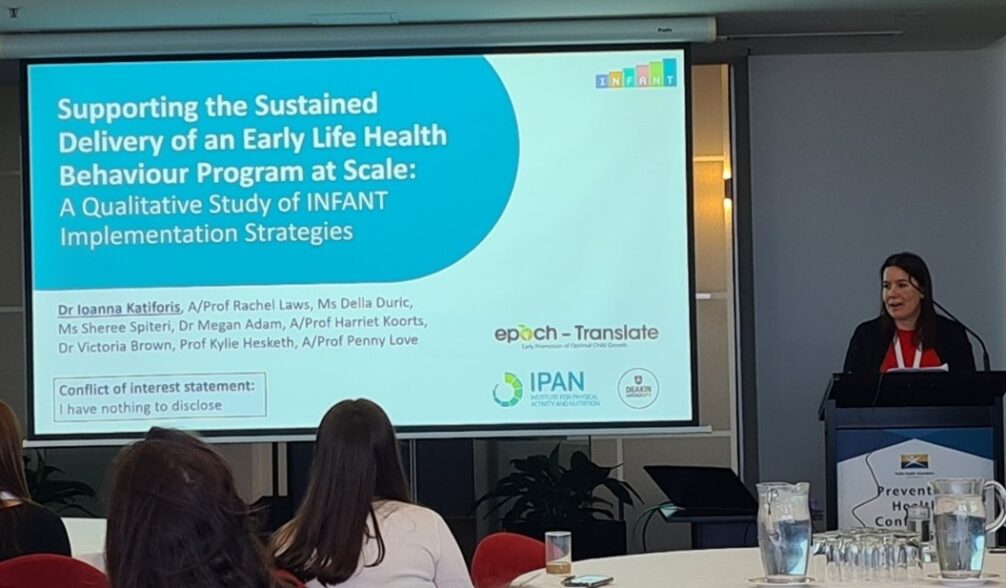
I delivered a long oral presentation titled ‘Supporting the sustained delivery of an early life health behaviour program at scale: A qualitative study of INFANT implementation strategies.’ This study provides insights into how Victorian local government areas implementing the INFANT: Infant Feeding Active Play and Nutrition program are using implementation strategies to support its sustained delivery at scale. While many early childhood health behaviour programs are initially adopted, sustaining them over the long term in real-world settings remains an implementation challenge.
The conference had a strong focus on community-led prevention efforts, with presentations from public health units and not-for-profit organisations highlighting community-based delivery models across diverse areas such as early education and care, schools, social services, and Aboriginal and Torres Strait Islander health services. Co-design approaches with community members, place-based implementation, and collaborative partnerships were identified as key factors strengthening the potential for sustainability. It was also evident that frequent and ongoing communication with end users of initiatives is essential to ensure programs are appropriate to their needs and can be adapted without compromising their effectiveness.
Another focus area of the conference was the commercial determinants of health. Professor Mark Pettigrew from the London School of Hygiene and Tropical Medicine delivered an engaging presentation on the need for public health to counter the influence of industries producing health-harming products, such as ultra-processed foods. He argued that the systemic and environmental drivers of poor health require regulatory and policy change, and that, while these upstream approaches are often the most challenging to implement politically, they have the greatest population-level impact. Researchers were also encouraged to be mindful of potential biases in industry-funded research and to consider the motivations of industry when funding academic research studies.
I enjoyed the broad range of topics presented at the Preventive Health Conference, and the opportunity to hear from academic researchers, as well as passionate public health practitioners and advocates all working to improve the health of our societies. I am very grateful for EPOCH-Translate for funding my attendance.