Strengthening Systems for Early Childhood Obesity Prevention: Reflections from ISBNPA 2026
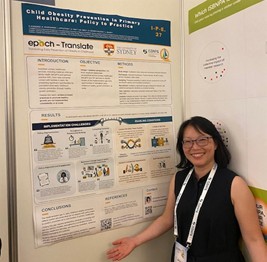
Dr Konsita Kuswara, a postdoctoral fellow with Stream 3, was supported by CRE EPOCH-Translate to attend the International Society of Behavioral Nutrition and Physical Activity (ISBNPA) conference, held in Cadiz, Spain, from 27–30 May. She shares her reflections from the conference.
In the beautiful summer Spain, over 1300 delegates from all over the world gathered to discuss the latest advances in behavioural nutrition and physical activity research. The conference provided an opportunity to share emerging evidence, explore innovative methods, and reflect on the challenges of translating research into population-level impact.
At the conference, Dr Kuswara presented a poster on her research exploring how early childhood obesity prevention can be better integrated into routine primary healthcare services in Australia. Using a systems thinking approach, the study examined the perspectives of 34 primary healthcare practitioners, managers and policy leaders.
The study found that while practitioners viewed prevention as an important part of their role, several factors made it difficult to consistently discuss and support healthy growth with families. These included fragmented services, limited time and resources, and broader social, cultural and environmental influences on family health behaviours.
The findings suggest that strengthening early childhood obesity prevention in primary healthcare will require system-level action rather than relying solely on individual practitioners. Potential opportunities include improving coordination between services, embedding obesity prevention more explicitly within clinical guidelines, strengthening workforce capability and professional networks, and developing funding models that better support preventive care.
These challenges resonated strongly with research presented from other countries. Across diverse settings, researchers described similar difficulties in achieving population-level improvements in nutrition and physical activity within systems that are often not designed to prioritise prevention. The conference reinforced the view that many public health challenges are shaped by interconnected factors operating across healthcare, policy, community and environmental systems.
A notable theme throughout the conference was the growing application of systems science to better understand and address these complexities. While systems approaches have long been established in fields such as engineering and organisational management, their application in public health is comparatively recent. Much of the early work in this area focused on mapping system complexity and identifying barriers to change. Although valuable, these approaches sometimes left stakeholders with a clearer understanding of the problem but less clarity about potential solutions.
Encouragingly, many presentations demonstrated how the field is evolving beyond describing complexity towards identifying practical pathways for action. Emerging methods and tools, including the Qualitative Systems Exploration Model (QSEM), system archetypes, and the Food Systems Transformation Solution Bank Tool, were presented as approaches to support decision-making and systems change. The OBCT project also showcased a policy implementation toolbox designed to support whole-of-systems approaches to childhood obesity prevention among socioeconomically disadvantaged families across four European countries.
As systems science continues to mature, there appears to be a growing emphasis on identifying actionable strategies to drive change. However, a recurring question throughout the conference concerned who is responsible for translating these insights into action. As the evidence base for systems approaches strengthens, greater attention may be needed to understanding how researchers, practitioners, policymakers and communities can work together to implement and sustain change.
The conference highlighted that advancing public health requires not only a deeper understanding of complex systems, but also greater consideration of the mechanisms through which evidence can influence policy and practice. For researchers working in prevention, this raises important questions about the role of advocacy, partnership-building and knowledge translation in achieving meaningful population health impact.
Dr Konsita Kuswara: Konsita.kuswara@sydney.edu.au