Highlights from Evidence and Implementation Summit 2025 in Melbourne, Australia
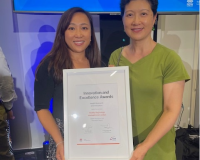
Dr Ioanna Katiforis, Postdoctoral Research Fellow at Deakin University and EPOCH-Translate Knowledge Translation Coordinator, reflects on her experience attending the Evidence and Implementation Summit 2025.
I was fortunate to attend the Evidence and Implementation Summit (EIS) 2025 in Melbourne from 28-29 November, with funding support from the EPOCH-Translate CRE. The EIS is an international conference that brings together researchers, policymakers, practitioners, implementation scientists, funders, consultants, and organisational leaders, all united by a shared goal: improving people’s lives through better use of evidence and implementation. I presented my abstract: Effective Implementation Strategies to Support Scale-Up and Sustainment of an Early Childhood Health Behaviour Program: INFANT, as a lightning talk.
This year’s summit theme, ‘Fairer, faster, better – Realising the promise of evidence and implementation to improve lives’ highlighted a strong focus on equity, lived experience, and community partnerships. Many speakers emphasised the importance of embedding lived experience and applying an equity lens throughout the implementation process.
I was particularly interested in sessions exploring scalability:
Dr Wong and Ms Manoharan from Singapore’s Ministry of Health Office for Health Transformation presented an impressive case study on scaling and sustaining a health innovation at the systems level. They used a hybrid approach combining implementation and improvement science to nationally scale up an intervention for kidney dialysis patients in the community. Moreover, they established a dedicated, multidisciplinary ‘spread team’, mapped key stakeholders, gained a detailed understanding of their contexts and developed context-specific implementation strategies, and monitored and evaluated implementation comprehensively.
Dr Gul, Head of the Implementation Lab at the University of Technology Sydney, delivered a thought-provoking presentation on the complexity of scaling up evidence-based health innovations. She highlighted that scaling must begin with complexity rather than seeking simplified answers to ‘what works’. We must also consider how we assess barriers and facilitators to ensure personal experiences and context are captured, design adaptable implementation strategies, and strive to address the structural drivers of inequitable access to health innovations.
Finally, there was a timely session on artificial intelligence (AI). Professor Elliott, co-founder of the Future Evidence Foundation, presented on AI at the intersection of research and practice. He noted that while advances in AI technologies have made research faster, easier, and cheaper, they also pose significant challenges, including an increase in low-quality or even fraudulent research papers. Moving forward, researchers must reflect on how to uphold core principles of research integrity (honesty, rigour, transparency and open communication, care and respect, and accountability) in this changing landscape where AI platforms are increasingly mediating knowledge.
As an early career researcher new to the field of implementation science, I found the summit highly valuable. It provided excellent insights and best-practice examples of how implementation science is applied to solve real-world problems across diverse sectors and encouraged me to consider how I could apply these approaches in my own research.